
Resources
Technical information
The key technical points behind Dasic tank cleaning and gas freeing equipment.
ATEX
ATEX certification
Any tank containing vapours, gases or dust is potentially explosive. The Orbitor range can be certified for use in ATEX Zones 0/20, the most hazardous potentially explosive environments, and certification is available on request.
Certification was awarded by a certifying body after assessment of the Orbitor’s design, materials and operation and a review of our manufacturing facility and methods.
- Zones 0/20, gas and dust
- Maximum operating pressure 12 bar
- Maximum operating temperature 60°C
- Water-based cleaning fluid: 0 to +60°C
- Diesel and light mineral oils: −20 to +30°C
- No volatile or flammable solvents
ATEX
Orbitor ATEX range
| Machine | Tank diameter / cleaning area | Wash pattern |
|---|---|---|
| Orbitor 100 | Up to Ø12 m | 360° |
| Orbitor 4 Nozzle | Up to Ø26 m | 360° |
| Orbitor Double Nozzle | Up to Ø29 m | 360° |
| Orbitor Hi-Cap | Up to Ø42 m | 360° |
| Orbitor Dualhead | Up to Ø30 m | 180°–85° |
Materials & finishes
Materials and surface finishes
Orbitor machines are made with 316L stainless steel bodies, PEEK gears and Carbon PTFE bushes. Marine machines such as the Junior Bronze use Gunmetal LG2 with brass bushes.
Most Orbitor machines are available in two finishes: standard for general industrial use, and highly polished for hygienic use. On the Orbitor 4 Nozzle the hygienic finish is 0.8 Ra internal and 0.5 Ra external.
Performance
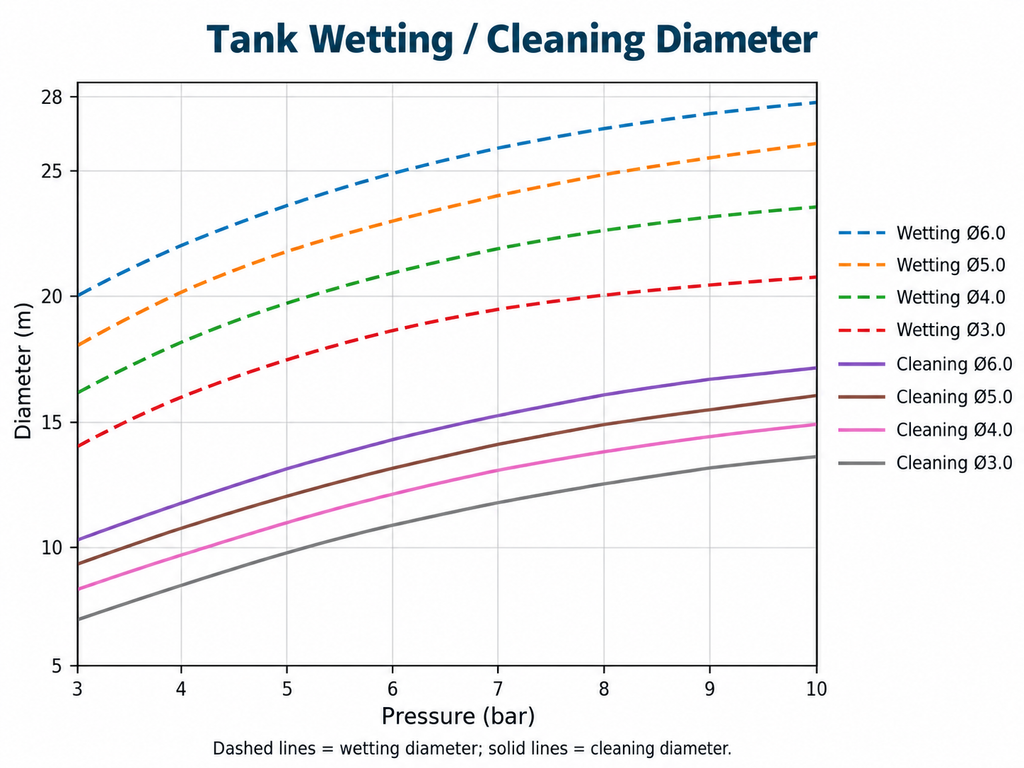
Jet length, wetting and cleaning diameter
Wetting diameter is the area reached by the jets. Cleaning diameter is the area over which effective mechanical cleaning is achieved. Both depend on the supply pressure and nozzle size, and each product page shows the data for that machine.
Flow and pressure should be measured at the cleaning head, not taken from the pump rating. Where that isn’t possible, the pump output, pipe lengths and diameters give a useful estimate.
Recirculation
Filtration and recirculation
If cleaning fluid is recirculated, adequate filtration must be provided. Filters of 500 to 1000 micron are ideal, as long as they are large enough not to restrict flow and pressure to the machine. Remember to allow for cleaning the filters themselves.
If a scavenge pump removes liquid from the tank, its settings must match the inlet flow. Otherwise liquid pools in the tank and reduces the cleaning action.
Gas freeing
Safe tank entry
A cargo tank should not be entered unless the oxygen content is 21% and the hydrocarbon vapour content is below 1% of the lower flammable limit. Where the previous cargo contained hydrogen sulphide or other toxic contaminants, the tank should also be checked for those gases.
Deep-penetration, high-volume fans blowing air into the tank give the fastest gas freeing. All Dasic Jetfans are of this design.
